


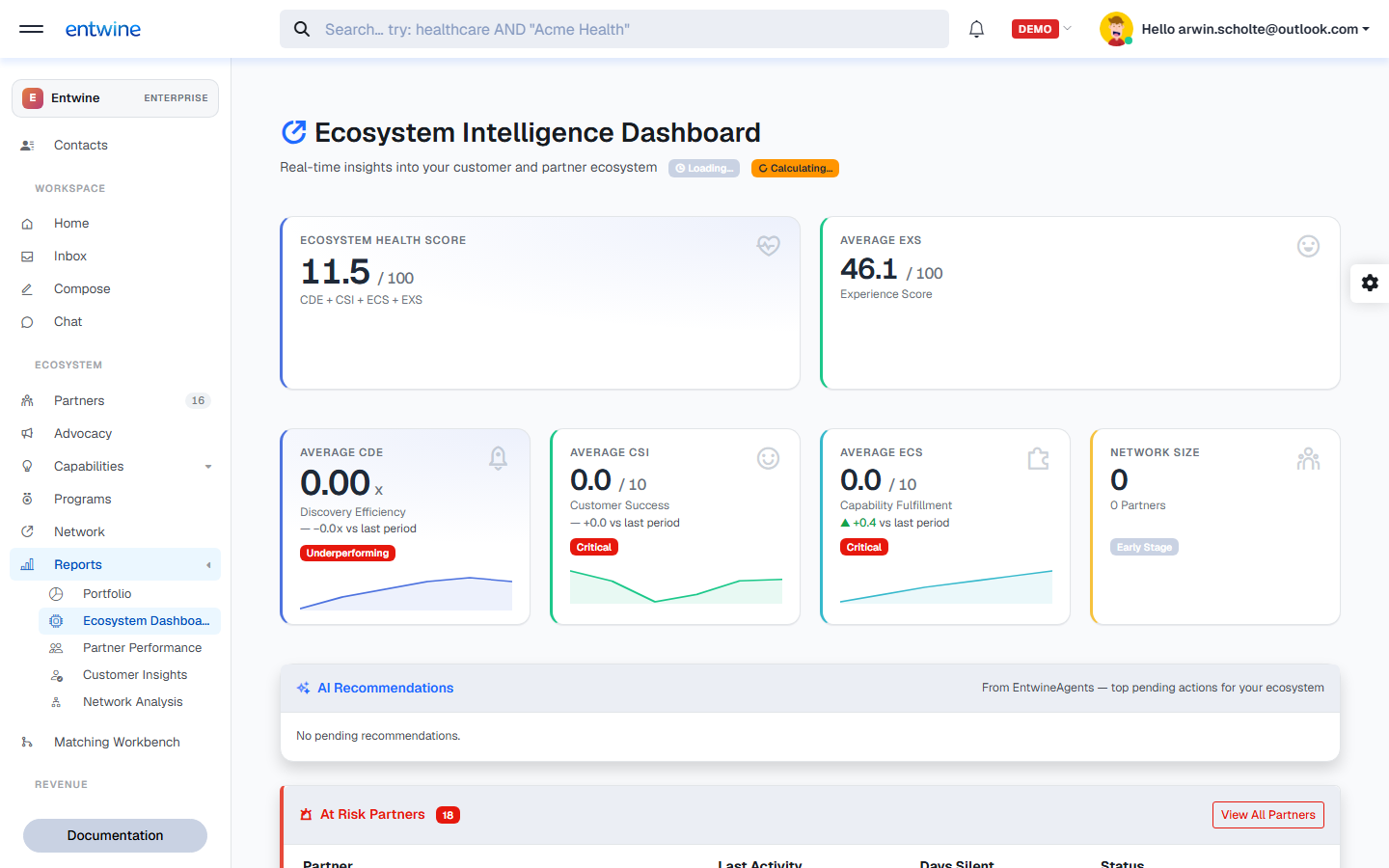
Last week we measured how fast your ecosystem gets a customer from need to signed deal. This week: what happens after the signature, which is where most partnership measurement quietly gives up.
The claim under test this time is bigger than speed. It is the claim that partners make customers more successful, not just easier to acquire. The Customer Success Index, CSI, is our attempt to make that claim falsifiable.
What CSI actually measures
CSI is a weighted average over five components of a customer’s health, scored 0 to 10:
Product adoption. Is the customer actually using what they bought?
Engagement quality. Are the delivery engagements around this customer healthy, moving, and completing?
Advocacy. Has the customer become a reference, a case study, a referrer? Advocacy is the strongest lagging indicator of success there is, because nobody advocates for a product that is failing them.
Business outcomes. The commercial trail: renewals, expansion, realized value.
Customer sentiment. What the customer says when you ask, folded in from survey responses and support experience.
Each component gets a weight, and the weights are yours to set. A product-led company might load adoption; a services-heavy one might load engagement quality. The defaults are sensible, but the point is that “success” is defined by you, in configuration, not hardcoded by us. That will be a recurring theme in this series: the platform computes, the client defines.
The honesty rule: missing data is missing
Here is the design decision we sweated most, and the one I would push any vendor on if I were evaluating tools in this category.
What should a success score do when a component has no data? Say you run no surveys, so there is no sentiment signal at all. Most scoring systems quietly substitute a neutral value, a 5 out of 10, and roll it in. The result looks complete and is subtly fabricated: your score now contains a number nobody measured.
CSI refuses to do that. A component with no data is excluded, and the weights renormalize over what is actually present. Run no surveys and your CSI is a real average of the four components you do measure, not four real numbers plus one invented one.
And there is a floor. If too little of the weighted picture is present, the score is withheld entirely. Not zeroed, not defaulted: withheld, with a list of exactly which inputs are missing. An empty score that tells you why it is empty is more useful than a fabricated one that tells you nothing.
We removed every trace of neutral filling from the calculators some releases ago and never looked back. If a metric is going to sit in a quarterly review and drive decisions about partners and customers, every digit in it has to trace to something that happened.
Where partners come into it
CSI is a customer score, but its purpose is a partner question: which partners are attached to customers that succeed?
Line up your partners against the CSI of the customers they touch and the four depths of partnership become visible in your own data. A transactional partner (depth one) shows up at acquisition and vanishes; the CSI of their customers is whatever your own team makes of it. An implementation partner (depth two) lifts early adoption. A success-level partner (depth three) leaves fingerprints across adoption, engagements, outcomes, and eventually advocacy. That difference, visible per partner on a dashboard rather than asserted on a slide, is what lets you invest in depth instead of just counting logos.
This is also the pairing that makes last week’s metric honest. A high CDE with a low CSI means your ecosystem finds deals quickly but hands over customers who then struggle. Speed of discovery is the door; lifecycle contribution is the house. You want both numbers, side by side, before you call a partnership strategic.
What to do with your number
Score withheld? Read the list of missing inputs as a to-do list. Usually the first gap is sentiment: a simple recurring survey fixes it in a quarter.
High CDE, flat CSI: stop widening the funnel and start asking what happens in onboarding. The partners you need next are implementation and success partners, not more referrers.
CSI rising where a specific partner is involved: that partner is quietly doing lifecycle work. Name it, measure it, and build the relationship deeper. This is the L3 conversation, and most ecosystems never have it because nobody had the number.
As with CDE, you can approximate this in a spreadsheet: five columns, your own weights, and the discipline to leave cells blank instead of guessing. If you would rather have it computed continuously per customer and per partner, with the missing-input list telling you what to instrument next, that is what Entwine does. The free workspace monitors five relationships, no credit card: entwineapp.io.
This is part 2 of a series on the three ecosystem metrics. Part 1 covered CDE, Customer Discovery Efficiency. Next: ECS, the Ecosystem Completeness Score, and the uncomfortable question of how much of your customers’ needs your ecosystem cannot yet meet.